
India's industrial production recorded a significant 7.3 per cent year-on-year growth in June, primarily fuelled by a strong performance in the manufacturing sector and robust expansion in electricity and gas supply.
India's industrial production increased by 6.7 per cent in July 2026, primarily driven by a 7.3 per cent growth in the manufacturing sector and a strong 8.7 per cent rise in electricity and gas supply, despite a contraction in the mining sector.
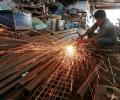
India's industrial production saw a 5.2 per cent increase in February, primarily fuelled by a significant improvement in the manufacturing sector, with 14 out of 23 industry groups recording positive growth.
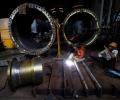
India's industrial production growth decelerated to a five-month low of 4.1 per cent in March, primarily due to the subdued performance of the manufacturing and power sectors, exacerbated by the West Asia crisis.

India's industrial production expanded at a slower pace of 4.9 per cent in April, primarily due to tepid growth in the energy sector amidst the West Asia crisis. This data marks the first release under the newly revised base year of 2022-23 for the Index of Industrial Production (IIP).
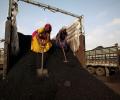
India's nine key infrastructure sectors recorded a three-month low growth of 4.8 per cent in August, primarily due to reduced production in coal, natural gas, crude oil, and fertiliser, according to government data.
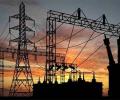
India's industrial production rose 19.6 per cent in May 2022, according to the official data released on Tuesday. As per the Index of Industrial Production (IIP) data by the National Statistical Office (NSO), the manufacturing sector's output grew 20.6 per cent in May 2022. In May 2022, the mining output climbed 10.9 per cent, and power generation increased 23.5 per cent.
India's industrial production rose 1.9 per cent in March 2022, according to official data released on Thursday. As per the Index of Industrial Production (IIP) data released by the National Statistical Office (NSO), the manufacturing sector's output grew 0.9 per cent in March 2022. Mining output climbed 4 per cent, and power generation increased 6.1 per cent.

India's wholesale price-based inflation surged to 11.39 per cent in September, up from 9.92 per cent in August, primarily driven by increasing prices of food, manufactured items, and fuel and power.

Industrial production declined by 8 per cent in August, mainly due to lower output of manufacturing, mining and power generation sectors, official data showed on Monday. According to the Index of Industrial Production (IIP) data, manufacturing sector production registered a decline of 8.6 per cent, while the output of mining and power segments fell 9.8 per cent and 1.8 per cent, respectively.
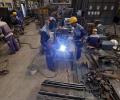
Industrial production rose 3.6 per cent in October, mainly due to better performance of manufacturing and electricity generation sectors, official data showed on Friday.

India's industrial production growth slowed to 3.8 per cent in December 2023, mainly due to poor performance of mining and power generation segments, according to official data released on Monday. The factory output growth measured in terms of the Index of Industrial Production (IIP) was at 5.1 per cent in December 2022. In November last year, IIP growth stood at 2.4 per cent.
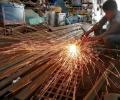
India's industrial production slipped to an 18-month low, contracting by 0.8 per cent in August, mainly due to a decline in output of the manufacturing and mining sectors, according to official data released on Wednesday. The data showed that the previous low in industrial output growth was a contraction of 3.2 per cent in February 2021. Factory output, measured in terms of the Index of Industrial Production (IIP), had expanded by 13 per cent in August 2021. The IIP grew by 2.2 per cent in July this year.

US Secretary of State Marco Rubio visited Reliance Industries' Jamnagar refinery, a day after calling India a crude oil refining 'superpower', and met with top Indian business leaders Gautam Adani and N Chandrasekaran to advance bilateral ties in energy, trade, investment, and defence.
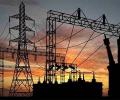
India's industrial production rose by 7.1 per cent in November 2022 after contracting in October, according to official data released on Thursday. The Index of Industrial Production (IIP) grew by 1 per cent in November 2021.

Manufacturing sector production registered a decline of 17.1 per cent, while the output of mining and power fell 19.8 per cent and 10 per cent, respectively.
After a gap of nearly two years, India's industrial production turned negative as it contracted by 0.1 per cent in August, mainly due to a decline in the mining and power generation sectors' output, in addition to an almost flat expansion in the manufacturing sector. According to the data released by the National Statistical Office (NSO), factory output growth based on the Index of Industrial Production (IIP) has also been revised downwards for July to 4.7 per cent from the earlier estimate of 4.8 per cent. "The IIP growth rate for the month of August 2024 is (-) 0.1 per cent, which was 4.7 per cent in the month of July 2024," NSO said in a release.

India's services sector experienced its strongest growth in three months in September, with the HSBC India Services PMI Business Activity Index rising to 55.2, driven by a sharp increase in new orders and strengthening domestic demand.

India's wholesale price-based inflation (WPI) increased to 9.92 per cent in August, up from 9.78 per cent in July, primarily due to rising prices across food, manufactured items, and fuel and power sectors.

India's industrial production rose to 5.2 per cent in May from 4.5 per cent in April 2023, mainly due to good performance by the manufacturing and mining sectors, according to the official data released on Wednesday. The factory output growth measured in terms of the Index of Industrial Production (IIP) stood at 19.7 per cent in May 2022, mainly due to a lower base effect. "The growth rates over corresponding period of previous year are to be interpreted, considering the unusual circumstances on account of COVID 19 pandemic since March 2020," an official statement explained.
India's industrial production grew in double digit for the second month in a row at 12.3 per cent in June mainly due to strong performance by manufacturing, power and mining sectors, according to official data released on Friday. However, the data showed that the industrial output growth is lower than 19.6 per cent recorded in May this year. It was 6.7 per cent in April.
India's industrial production growth decelerated to 5.8 per cent in September from 10.3 per cent in August, though on an annual basis, the output of manufacturing and mining sectors showed an improvement, according to the official data released on Friday. The factory output growth measured in terms of the Index of Industrial Production (IIP) had grown by 3.3 per cent in September 2022. During April-September 2023-24, the IIP growth works out to be 6 per cent, down from 7.1 per cent in the corresponding period a year ago.

India's statistics ministry has defended its newly released economic growth estimates, stating that revisions to last year's GDP and the divergence between different price measures reflect updated data and estimation techniques rather than an attempt to artificially boost headline growth.

India's eight core infrastructure sectors recorded a two-month high growth of 1.7 per cent in April, primarily boosted by strong performances in steel, cement, and electricity production, according to government data.
India's industrial production rose 3.1 per cent in September, according to official data released on Friday. As per the Index of Industrial Production (IIP) data by the National Statistical Office (NSO), the manufacturing sector's output surged 2.7 per cent in September 2021.

For the April-January period of 2012-13 fiscal, the industrial production growth is at 1 per cent, down from 3.4 per cent in the same period of 2011-12, according to official data released in New Delhi on Tuesday.
India's industrial production growth decelerated to an 8-month low of 2.4 per cent in November, mainly due to poor showing by the manufacturing sector, according to the official data released on Friday. The factory output growth measured in terms of the Index of Industrial Production (IIP) was 7.6 per cent in November 2022. The previous low of IIP growth was recorded at 1.9 per cent growth in March 2023.

The industrial growth during July is estimated to have dipped to 5.6 per cent as against 7.1 per cent during the same month of 2002, despite a healthy growth of the manufacturing sector.
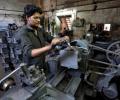
India's industrial production growth rose marginally to 5.6 per cent in February from 5.5 per cent in January 2023, mainly due to good performance of the power, mining and manufacturing sectors, according to official data released on Wednesday. There was an improvement on an annual as well as sequential basis. The factory output growth measured in terms of the Index of Industrial Production (IIP) stood at 1.2 per cent in February 2022.
The industrial production has been dismal at 2.8 per cent in 2011-12 as compared to 8.2 per cent in previous fiscal.

In terms of industries, 17 out of 23 industry groups in the manufacturing sector have shown negative growth.
On a cumulative basis, the Index of Industrial Production (IIP) for the first quarter this fiscal grew by 10.3 per cent as compared to 7.7 per cent in the year-ago period, according to the official figures released on Friday.

India's cement industry is on the brink of an oversupply situation as aggressive capacity expansion by major players is set to outpace demand growth over the next two financial years, potentially leading to pricing pressures and moderated utilisation rates.
India's industrial production grew at a two-year high of 6.7 per cent in November this year, driven by strong performances in mining and manufacturing, according to official data released on Monday.
Industrial production growth entered positive territory after a gap of two months with a record 22.4 per cent rise in March this year, mainly due to the low-base effect and good show by manufacturing, mining and power sectors. The manufacturing sector -- which constitutes 77.63 per cent of the index of industrial production (IIP) -- grew by 25.8 per cent in March 2021, as per the data released by the National Statistical Office (NSO) on Wednesday. The mining sector output too grew 6.1 per cent in March, while power generation increased by 22.5 per cent.
The manufacturing sector, which constitutes over 75 per cent of the index, grew barely 0.1 per cent, as against 5.7 per cent in April 2011, according to the official data released on Tuesday.
India's industrial production grew by a sluggish 11.1 per cent during December 2006 from a peak of 14.4 per cent a month ago.
As per the first quarter figures on industrial production released by Central Statistical Organisation on Friday, the electricity sector registered a growth of 8.3 per cent as against 5.3 per cent a year ago.
Growth in factory output, as measured by the Index of Industrial Production, was 6.2 per cent in May 2011, according to the official data released on Thursday.
IIP's contraction deals a severe blow to the Indian economy.
